Wednesday, October 3, 2018

Atypical skin manifestations of dengue fever in a child


Dengue fever is a severe flu-like illness that affects infants, children, adolescents, and adults and can have a wide variety of manifestations. Dengue fever can have varied skin manifestations including petechiae, purpura, and bleeding.
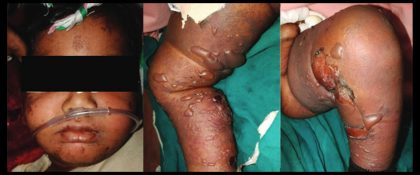
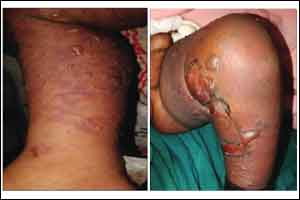
An 18-month-old male child was presented with the complaints of fever for 6 days, loose stools for 3 days, multiple skin lesions all over the body for 2 days, and skin eruptions for 1 day. The patient was apparently healthy 6 days ago when he started having a sudden onset, high-grade fever intermittent, progressive, and relieved on medications, associated with loose stools 18–20 times a day in frequency, watery, brownish in color, associated with various fluid-filled skin lesions, and eruptions for 2 days. Parents also complained of the patient having generalized joint pain.
On examination, the patient was conscious and irritable at the time of admission and was having a fever of 100°F, pulse rate of  138/min, low volume pulse, RR=32/min, blood pressure=98/64 mmHg, RBS=55 mg/dl, and spo2=98% at room air. The patient was having mild pallor, and facial edema, and various skin eruptions all over the body, petechiae over both lower limbs, and peeling of skin over face and lower limbs.
The child got better with fluid resuscitation, skin care, and supportive management. This case report draws light toward the various other dermatological manifestations of dengue fever
Atypical skin manifestations of dengue fever in a child

Monday, October 1, 2018

New Risk Factors Identified for Varicose Vein Disease

HealthDay News — New risk factors have been identified for varicose vein disease, including height, according to a study published online September 24 in Circulation.
Eri Fukaya, MD, PhD, from the Stanford University School of Medicine in California, and colleagues applied machine learning to agnostically search for varicose vein risk factors in a cohort of 493,519 individuals in the UK Biobank. Predictors were further studied for 2441 incident events. A genome-wide association study of varicose veins was also performed among 337,536 unrelated individuals (9577 cases) of white British descent.
The researchers found that several known risk factors were confirmed with machine learning (age, sex, obesity, pregnancy, history of deep vein thrombosis), and several new risk factors were identified, including height. Greater height remained independently associated with varicose veins after adjustment for traditional risk factors (hazard ratio for upper versus lower quartile, 1.74). Thirty new genome-wide significant loci were identified in a genome-wide association study, identifying pathways involved in vascular development and skeletal/limb biology. There was evidence that increased height was causally related to varicose veins in Mendelian randomization analysis (inverse-variance weighted: odds ratio, 1.26). 

Thursday, September 27, 2018

World Contraception Day 2018

Every year, September 26 is observed as World Contraception Day and the motto of this year is to create awareness about several methods of contraception available around the world. It is essential, especially in a densely populated country like India where the topic of sex and contraception are taboo.
India holds the second largest population in the world after China, hence, creating awareness about contraception is an absolute need of the hour.
WHO describes the theme of the World Contraception Day as: “The day’s mission is to improve awareness of all contraceptive methods available and enable young people to make informed choices on their sexual and reproductive health.” 


Wednesday, September 19, 2018

Shocking: Leprosy-free India Has More Than 1.3 Lakh Reported Cases


India has been announced as a leprosy-free country, 13 years back; but in 2016, 1.3 lakh new leprosy cases were found. Experts say it is an understatement about cases. According to the recent report published in the Lancet, after the 2005 announcement, the government did not look into leprosy cases.
As per the survey conducted by the Indian Council of Medical Research (ICMR) in 2008 – 2011. An estimated number of 250,000 new leprosy cases were discovered in India, each year.
It is known that leprosy is a chronic infectious disease caused due to Mycobacterium leprae and it is transmitted via droplets from the mouth and nose. The infection can affect the skin, peripheral nerves and eyes. Leprosy may also lead to the nerve damage and disfigurement.
Considering the constant harassment suffered by leprosy patients, the recently, Supreme Court said there should be no discrimination against leprosy patients and adequate rehabilitation should be provided for them.
Source- The Print

About Me